Showing posts with label Saskatchewan. Show all posts

Friday, March 23, 2012

My Letter to Premier Brad Wall in support of the Film Employment Tax Credit

Recently, the Government of Saskatchewan announced its intention to axe the Film Employment Tax Credit. Here's how I feel about it. A copy has been sent to Brad Wall. If you agree, if you have worked in the business, if you have felt the positive effect of Saskatchewan's film industry, or even if you enjoyed watching Corner Gas, you really ought to contact the Premier yourself and ask him to continue the incentive.
----

Dear Premier Wall,

My name is J. Adrian Cook, writer and musician from Harris, Saskatchewan.

I dread the end of the Film Employment Tax Credit. This is not because I am planning to film in Saskatchewan. My dread is also not for my writing career, though it may limit my options as a screenwriter. My dread is also not for my future on set, though I have been sustained in the past by roles as an extra and production assistant. My finances will not be directly stung.

The reason for my dread is that I will say goodbye to so many friends. These are people who work in the film industry and whose livelihoods will be devastated. For years, they have made their living from foreign production companies enriching in our province. Now, these companies have little reason to film here. Their money will evaporate. If my friends wish to follow their dreams or even sustain themselves, they will have to move to Vancouver or Toronto.

I am no economist. I cannot speculate on the monetary result of the cancellation of the incentive. However, I can accurately speculate what will happen to my friends.

I am friends with screenwriters. For them, the end of the program will affect them slowly. Writers can write anywhere, but it helps to be near filming. Making film connections is important for them and if they cannot make them in Saskatchewan they will have to leave.

I am friends with actors and grips. These people can find work in local professional theatre if they are lucky. However, this is a limited job market and it will not provide for them. They will leave sooner.
My unluckiest friends are the directors, cameramen, and production assistants. For them, there is no substitute: they need film or they starve. They will leave soonest.

I seem to recall the Saskatchewan Party criticizing previous NDP governments because of a brain drain. Ending the Film Employment Tax Credit will send hundreds of our brightest citizens packing. Me and my province will be poorer, lonelier and sadder.

Please reconsider cutting this program.

-J. Adrian Cook

Wednesday, February 9, 2011

Legend-haunted Saskatchewan

I was once riding a bus from Saskatoon to Edmonton. In my lap was a book of short stories inspired by The Shadow Over Innsmouth, by H.P. Lovecraft. After reading a particularly good one, I stared out the window at the summertime fields, imagining the rotting seaport of Innsmouth with its shuffling denizens. I imagined Lovecraft's Massachusetts: an ancient land with malicious things lurking in lonely places, a land where civilization is clapboarded onto a wild landscape and unimaginable creatures writhe at its edges. Here's a nice one of Innsmouth taken from darkmartin.net.

It is a compelling setting, one which easily lends itself to horror. Other writers have their own horror settings. Stephen King has his Maine. The early horror writers had scores of tumble-down European castles, mansions and abbeys for their ghosts to populate, settings which are now old-hat. But what about my home province, Saskatchewan?

This I pondered as the scenery whizzed past. I tried to see why Saskatchewan was scary. I imagined dark things lurking under the trees, creatures hiding in the fields, strangers gone missing, unspeakable acts committed in anonymity amongst the farmhouses.

I couldn't. All I could see was beauty. Everything was pleasant, canola was blooming, pollen was in the air, the sky was blue and golden. Outside, I knew a warm wind was tickling the aspens and if you strolled one of the dusty grid roads, curious people would wave from their trucks as they drove past. This land is inherently friendly.

Since then, I've been on a mission to find the scary in my province and mostly been frustrated. The scary is minimal or hackneyed. Nobody needs another Indian-burial-ground-ghost or squeal-like-a-pig-hillbilly troubling their literature. There are no abandoned castles here.

So after several years, here's what I've come up with. Rather than explain it to you in rant form, I'll use flash fiction. In no particular order, this is why Saskatchwan is scary:

1.
The orange farm light in the distance didn't seem to be getting any bigger. Daniel trudged along the bleak road. No moon lit his way, but the snow reflected cold starlight. The stars blazed innummerable and white above him. Cold wind blasted from them and stole his breath.

Daniel turned to shelter his bare face from the gust. The wind rattled the leafless poplars at the roadside and hissed in the snow. It leaked through his parka and chilled his legs under his jeans. He found his breath and stared to the indescernable horizon. He could no longer see his Toyota.

The wind passed over the wood and vanished onto the prairie, leaving figid silence. It blew still, but in a deadly whisper. The snow scrunched under his boots. In the dark, where his car should be, something black on the road moved.

He shut his eyes and spun back toward the farm light. He shielded his face, muttering, "I didn't see anything." But when he heard the echo of his snowy boots from the woods, the trees resounded another set of footfalls.
---
2.
The old wood creaked under Greta's step as her eyes adjusted. She was on a dance floor speckled with mouse droppings. An old stage loomed before her. Light spilling through broken panes revealed a pile of wheat husks at the far end of the hall where some farmer had stored grain. A podium was toppled against a dusty upright piano.

Here, decades ago, her great grandfather had tuned his violin. Her grandmother sat at the piano and her great aunt strummed a guitar in one of these overturned chairs. Where she stood, a vanished community had waltzed and jigged. It was a place of warmth and laughter.

The hall was not warm now. It was damp and musty. The only music was sung by distant meadow larks.

The roof creaked and settled in the prairie breeze. Greta rubbed her bare arms, flattening goose pimples. She felt like an intruder. She wanted to leave, but did not.

Instead, curiosity drew her to the piano. She lifted the lid from the keys. Real ivory shone in the dim. With a thumb, she played middle C. Her eyes widened. The note was in tune. Her fingers traced the first melody that came to mind, "The Blue Danube", each note well-tempered. She stopped when she felt something clammy clap on her shoulder.

A hollow voice asked, "Would you like to dance?"
---
3.
It wanders into town at night. When I first saw it in my headlights, I thought it was a bear. But giant eyes, round as the full moon, reflected back at me. It shuffled into the ditch and vanished into the endless forest.

When I see it, it makes no sound. It travels from house to house, wanders the landfill, opens sheds and outhouses and just looks. It rummages through piles of trash by the road to the airport and watches children on the playground swing set if they stay after dark.

It haunts certain people the most. It follows Wendy Bear every night, loping just beyond her vision as she staggers home from the hotel, drunk. It peeps in the Delorme's trailer window and watches Norman beat his wife. When I found that baby skeleton lying in the woods, it was crouched on a mound of moss in a nearby strand of jackpine.

I don't know if anybody else can see it. If they can, they don't tell anybody. Nobody tells anybody anything here. They just live with it.

I would leave town if I could, but I don't have the money. I never will. And every night as I light my glass pipe in the dark, I see the lighter's flame shining in its round eyes as it stares through my window.
---
That's what I've come up with. I'm sure this is not an exhaustive list. Dear readers, what do you find scary about Saskatchewan? I invite you to share. Relate a tale, post some flash fiction, or give me a mini-essay. Leave it in a comment, e-mail me or Facebook me. If I get at least three responses, I'll make a separate post and publish it here. Fire up your creative brains and let's hear it. Hokay? Hokay.

http://pharoahphobia.blogspot.com

Tuesday, September 7, 2010

Vanishing

Zoey wants to explore ruins. Sort of. My twelve-year-old niece mentioned it in passing as something we could do while she's visiting us in Harris. She thinks it would be creepy, and therefore fun. I'm not entirely sure that she was serious when we discussed it, but I was. I know that a ghost town called Valley Centre is located on Highway 768, so on the sunny Saturday before she is scheduled to leave Harris, Zoey dons proper exploring shoes and an embarassing shirt of mine that we don't mind getting dirty. We leash the dog, board the Mazda and drive the gravel highway looking for someplace "creepy".

The old Hillview schoolhouse is locked and, despite Zoey's urging, I am unwilling to force the door. We peer inside basement windows at a plastic Christmas tree and octopus boiler, then decide to move on. Set against the golden hills in the distance is a brown grain elevator. I am reasonably certain from my memory of Google Maps that Valley Centre is located on 768, but the distant elevator is north of the highway. Then again, Google Maps also thinks there is an Indian Reserve to the east of Harris and the Stonebridge neighborhood in Saskatoon is called "Stonerideg". We decide to check it out.

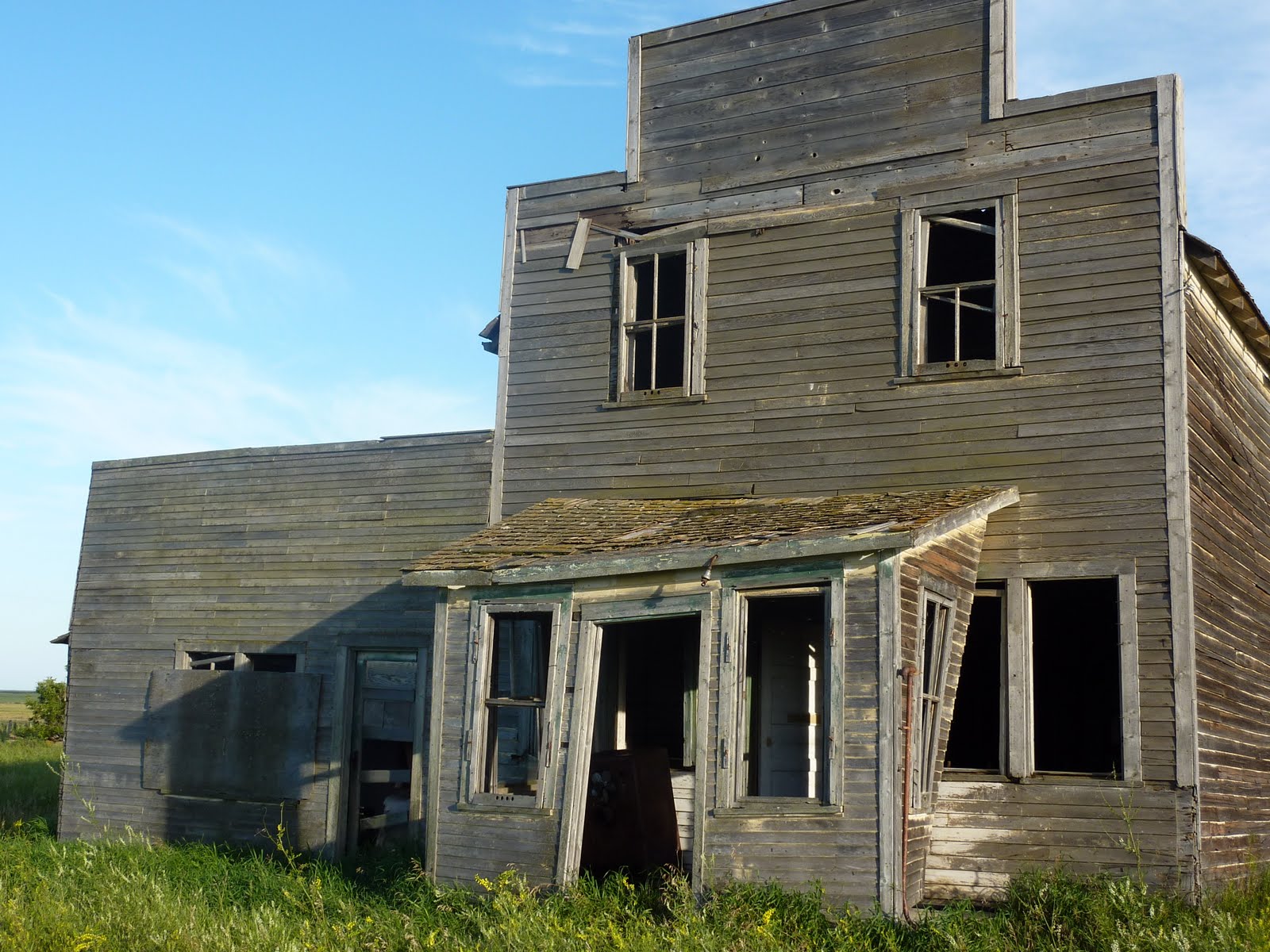
It is not Valley Centre. According to the faded paint on the elevator, it is Bents. I stop the car on the hill to prevent the undercarriage getting scraped by weeds on the disused track into town. To our right is an abandoned house with smashed windows and flaking white and red paint, beyond that is a cluster of wooden buildings greying with age. To our left is the elevator.

"Oh my god," says Zoey. I feel the same way. I had expected to explore some toppling farmhouse with outbuildings filled with old paint. This find is scarcely believable. Such places exist.


We decide to avoid the nearest house because it looks the most recently-occupied and for some reason I find this unnerving. We follow the track to what was obviously once the general store. We tell the dog to sit and stay outside the door. I enter first, partly because I have no idea how stable the structure is, partly because Zoey is skittish.


For an abandoned ruin, this store is surprisingly sound. It is dark inside but light leaks through broken panes. Where on tracks more beaten an old building like this would be thoroughly ransacked and looted by boozing teenagers and people like myself and Zoey, the Bents general store is surprisingly intact. Stock still sits on the shelves, including a display of women's shoes. Old appliances and cabinets lie open everywhere. In places the floor is plastered with ancient paper and piles of swallow shit.


A counter with a porthole in the wall separates the general store from what looks like a post office in a rear room. Tiny cubby holes are labelled "McNaughton", "Wylie" and other local family names. Here the layer of paper on the floor is thicker. Zoey discovers a pamphlet promoting John Diefenbaker's Conservative government from 1962. I smile to myself as we sift the papers and discover personal documents from the late fifties and early sixties. Confidentiality was apparently not a huge issue when this office was abandoned.


The dog is now whining and circling the building. Before we leave, Zoey searches the women's shoes to find a pair that match as a trophy. By now, any fear she felt in exploring this place has vanished. So has her search for identity: the need to prove herself as a good person, a bad person, or a pretty girl. In this desolate yet beautiful place, I am also seeing Zoey for the first time. She is adventurous and free-thinking and I am secretly pleased.

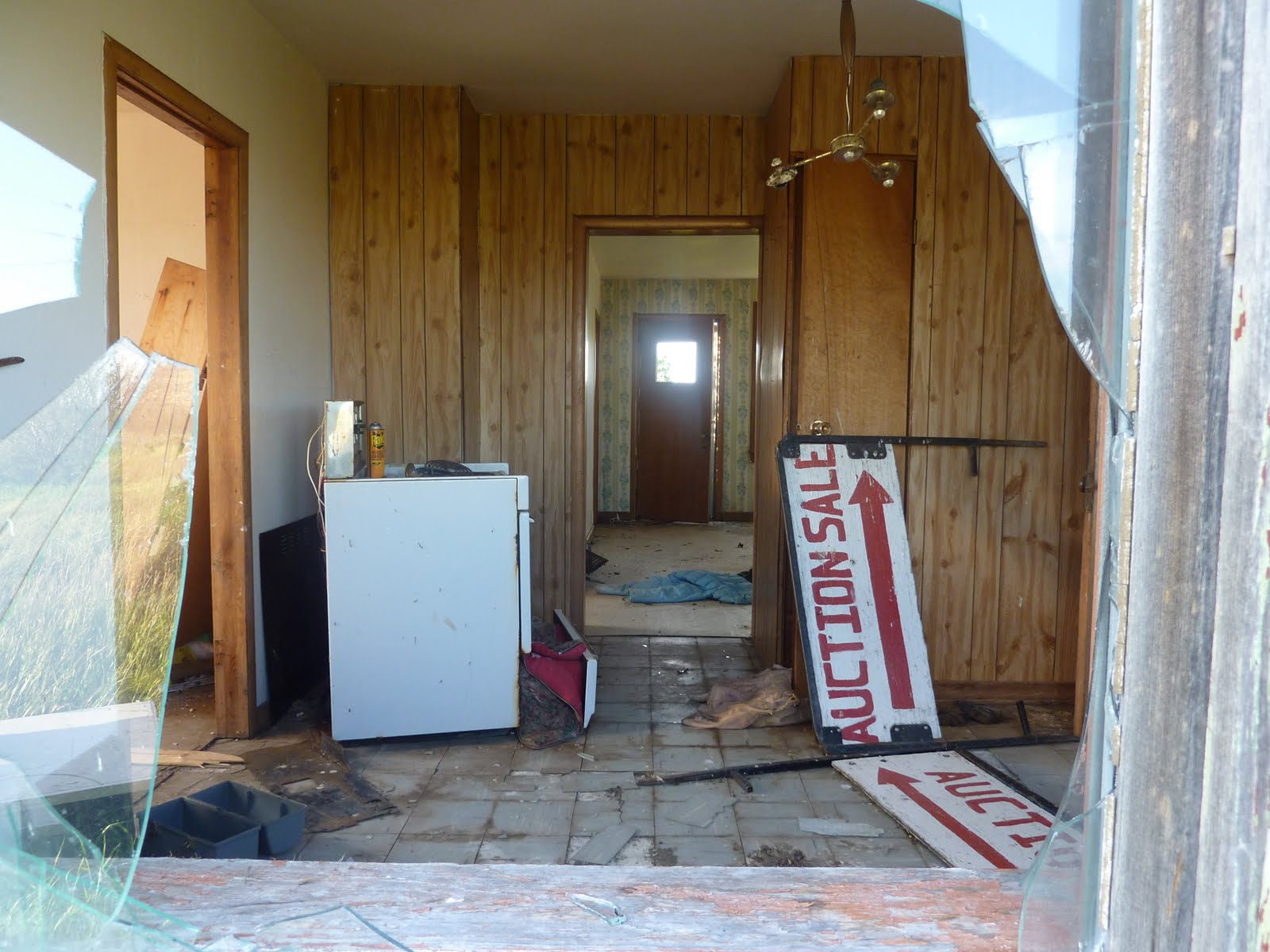
We stash a load of loot at the car and then head toward the first house we saw. Hundreds of swallows wheel around the old TV antenna. Inside are drooping light fixtures, swallow nests, wood panelling, a used bar of soap and signs for an auction sale.


Judging from the No-Name shopping bags lying on the bathroom floor, this house was abandoned in the late eighties or early nineties. The whole town of Bents must have been auctioned off in this way. The last resident of Bents, probably an octogenarian, lived in this house on the edge of this rotting town, watching it collapse. At last concerned family members or death pried them from this home and their life was auctioned for a pittance. If ghosts exist, one surely stares from the windows of this home, watching the remains of Bents slowly vanish beneath the grass.

The next house we explore is in worse shape. In the living room a rusty pram is sinking into the floor. Zoey and I have found the creepiest thing we will see today. As we are leaving, we discuss why it was so creepy. I tell her, "Icons of youth in the midst of death are always creepier than just death." She agrees.


Zoey can't help posing every time she sees me readying the camera. I try to secretly photograph her without much success as we search the grain elevator. The elevator shelters an enormous scale, old machinery for scooping wheat and rotting bowls full of screws and nails.


A sturdy-looking ladder leads to an upper floor. Zoey wants to climb it. I forbid her to do so. When she asks why, I tell her it's because I don't know anything about architecture and I wouldn't want to be the one to tell her dad that she was crushed when a grain elevator collapsed on her. She says, "So, if I was your kid you wouldn't have a problem with it?" I confirm.

Outside the elevator is a graveyard for farm machinery. As Zoey and the dog clamber around in it she speculates on the function of various contraptions. She believes that the tractor she is sitting on might still run. "Alright," I say, not wanting to shatter any fantasies. Zoey's mind is open and imagining possibilities in this place and I don't want to spoil it. Just by being here she's discovering volumes about the lives of long-dead Saskatchewan and I don't even have to say anything. I am proud of her again and keep my thoughts to myself.

As evening approaches the sky turns radiant and high clouds paint strange patterns in the eerie blue. It occurs to me that this moment is of such shocking reality and beauty that it is to be treasured forever. In my adulthood, I can recognize these moments as they happen, but when I was a child I had no idea. Now I have only scattered memories and regrets that I didn't pay more attention. I hope that Zoey will remember this moment as I will.


On our way back to the car, Zoey wants to get a picture of herself riding on a rusty swing set. It's awkward but she manages to take a seat and pose. The symbol is painful. There she is, a girl poised on the edge of maturity, the toys of childhood becoming uncomfortable, her youth vanishing as surely as Bents is vanishing. In twenty years she will be a freethinking woman and Bents will be but piles of windblown, grassy timber and iron.

All things must change and have their beauty. But for now my niece, this town and the prairie that surrounds us are perfect. I thank God that I remembered to bring the camera to capture them as they were in this moment.


http://pharoahphobia.blogspot.com/